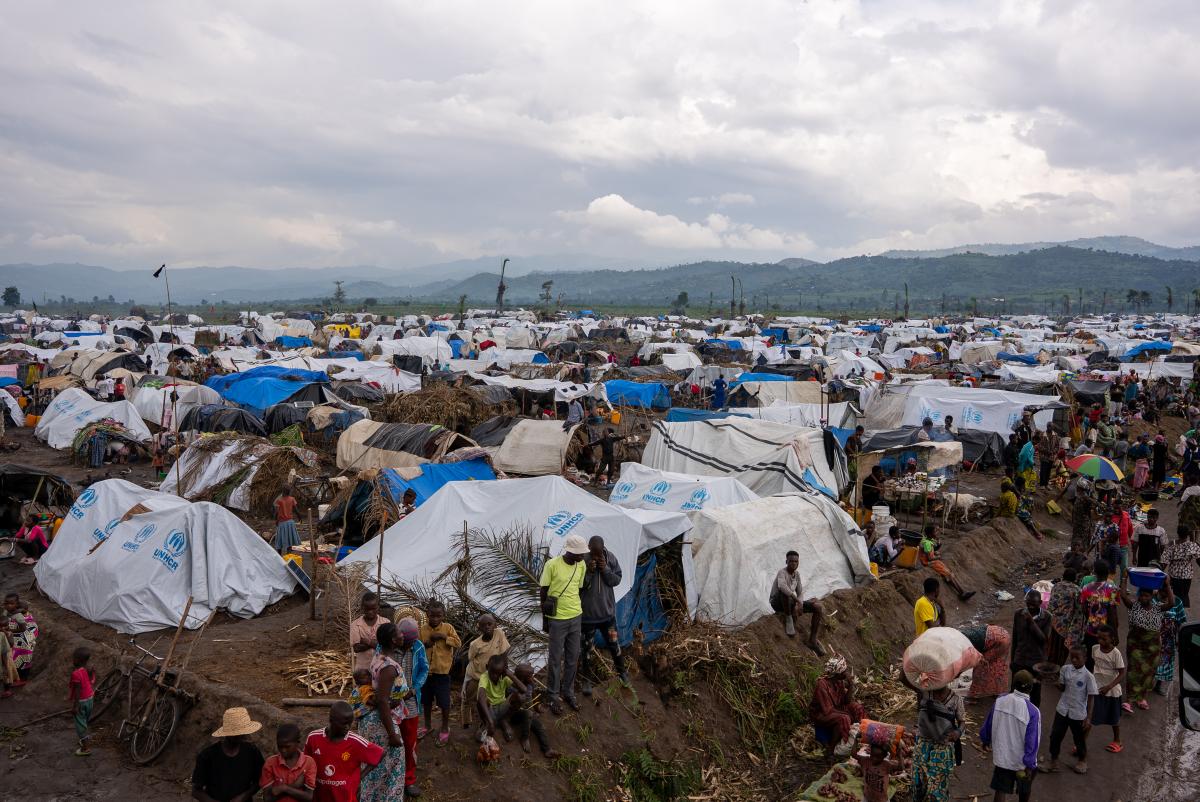
"The mud was sticking to my ankles. I couldn't lift my feet. And I was just there for a few hours. These people are living there."
Ruven Menikdiwela has spent 37 years working with refugees. She is the Assistant High Commissioner for Protection at UNHCR, the UN Refugee Agency. She has worked with refugees in Pakistan, Thailand, Western Sahara, and dozens of places in between. Her recent visits to Burundi and eastern Chad left a mark. We asked her what she saw, and what it tells us about the state of refugee protection today.
You recently visited Burundi. What did you find there?
"The Burundian government has received over 100,000 Congolese refugees since December. This is a tiny country with a very fragile economy that can barely look after its own citizens. And yet they opened the border. They said: these are our brothers, we don't want to force them back.
But they don't have the funding to look after these people properly. And neither do we, because not a lot of donors are interested in Burundi right now. Ukraine, Sudan, Myanmar, Afghanistan, those are the operations people look at. Burundi raises questions: where is it, and why should we be helping?
So when I visited the site where these refugees had been moved, 64% of them – people who had arrived since December – were still sleeping under plastic sheets. A sheet tacked to the ground, five family members inside. It was raining. The soil turned to mud. I was walking in mud for a few hours and couldn't lift my feet. These people are living there."
"They left eastern Congo with the clothes on their backs. Three months later, they're still in those plastic shelters. The food is about to run out."
Who is most at risk in these situations?
"Sixty percent of the people in that site are children. Many of them are unaccompanied: they lost their parents in the fighting between M23 and the Congolese government forces. They don't know where their families are. They're just running around, with no one to look after them.
And then there are the women. When you speak with them, many say they were raped in the DRC before crossing into Burundi. We try to make sure they get the services they need. But the heartbreaking truth is that with our current funding we can only reach less than 10% of them. Not because the programmes don't exist, but because we don't have the money.
It's the same in eastern Chad, where 80% of the Sudanese refugees arriving are women and children. Seventy percent of those women have been raped. I spoke with an 80-year-old woman who had survived this violence. After 35 years in this field, listening to these women describe what happened to them, left me profoundly shaken."
Is funding really the core problem?
"It is one of the biggest obstacles. Chad has kept its borders open. Burundi has kept its borders open. South Sudan. Central African Republic: all fragile countries, all receiving enormous numbers of people.
Let me give you one figure. Last year, 110,000 people arrived at Europe's land and maritime borders. During the same period, 800,000 Sudanese refugees crossed into Chad alone. Everyone talks about the 110,000 figure. Nobody talks about the 800,000, or about Chad, which kept its doors open with almost nothing to offer them.
There was also a cholera outbreak in the Burundi refugee site just weeks before my visit. Refugees in eastern Chad with bullet wounds were sitting in reception centres three days after arriving, waiting for a number to be called, because the clinics were completely overwhelmed. These are the tragic gaps when the money isn't there."
"Nobody ever says, when I grow up, I want to be a refugee. It is often the consequence of circumstances beyond anyone’s control."
What would you say to someone in Switzerland reading this?
"Every one of those statistics – 117 million displaced people worldwide – is an individual tragedy. Someone who didn't do anything to deserve what they're going through. I didn't wake up this morning wondering whether my home would be bombed, or whether there would be a hospital nearby if I fell ill. That is the daily reality for refugees. We need to keep remembering that.
Nothing is too small. High school students raised 2,400 CHF through bake sales and brought it to us. They didn't know exactly the full scope of UNHCR operations – they just knew they wanted to help displaced people. That matters. Every contribution reaches someone who has nothing left."
FAQ on the situation in Burundi and Chad
What is happening to Congolese refugees in Burundi?
Since December 2025, over 100,000 Congolese refugees have fled into Burundi following fighting between M23 forces and the Congolese army. Many remain in makeshift sites without adequate shelter, food, or healthcare due to severe funding shortfalls.
Why is UNHCR underfunded in some crises?
Donor attention – and funding – tends to concentrate on high-profile conflicts. Smaller or less visible crises, like those in Burundi or Chad, often receive a fraction of what is needed, leaving UNHCR and partner organizations unable to provide basic services to refugees.
What is gender-based violence in refugee settings?
Gender-based violence (GBV) includes rape and sexual assault, which can occur both during flight and in displacement settings. In some conflicts, such as Sudan, sexual violence is used deliberately as a weapon of war. UNHCR works to identify survivors and connect them with support services, though funding constraints severely limit reach.
How does UNHCR protect unaccompanied children in refugee camps?
UNHCR registers and identifies unaccompanied and separated children as early as possible, then works to establish care arrangements – either with extended family, or dedicated foster facilities – to ensure their safety and wellbeing.
How can I help refugees in forgotten crises?
Donating to organizations like UNHCR is one of the most direct ways to help. Funds go towards shelter, healthcare, access to clean water, child protection, and support for survivors of violence in underfunded operations around the world.