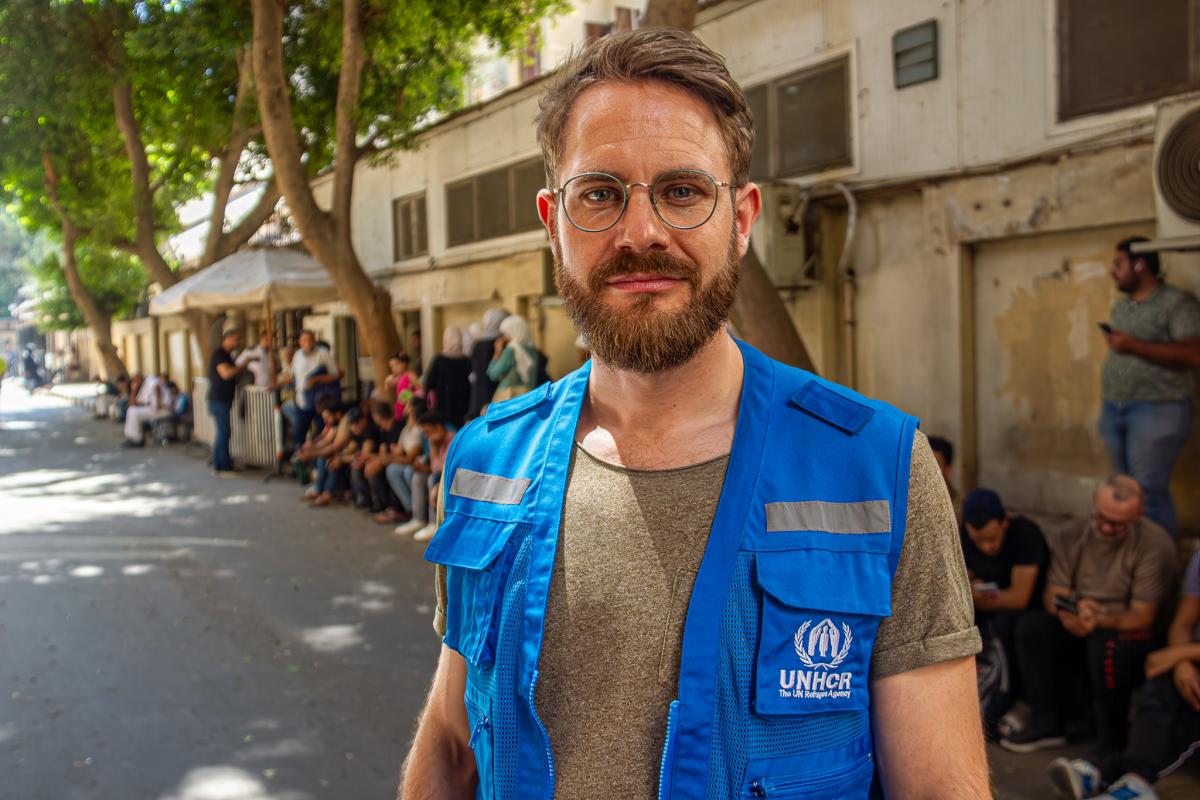
An interview with Sebastian Herwig, UNHCR External Relations Officer in Cairo
Sudan is now the world’s largest displacement crisis. Nearly twelve million people have been forced to flee their homes. That is one in three Sudanese. Most of them have fled to neighbouring Egypt. Yet despite the staggering scale, the crisis remains almost entirely absent from global headlines. In Cairo, where hundreds of Sudanese refugees still approach UNHCR for registration every day, Sebastian Herwig, UNHCR External Relations Officer, witnesses the emergency up close. We spoke with him about what he sees, why this crisis remains invisible, and what keeps him going.
You’ve worked in humanitarian response for more than a decade. How does the Sudan crisis compare?
Sebastian Herwig:
The scale of the Sudan crisis is extraordinary. Nearly 12 million people have been displaced. That means every fourth Sudanese has been forced to flee, and one in thirteen refugees worldwide is Sudanese.
In Egypt, the impact is dramatic: since the start of the war, the number of registered Sudanese refugees has seen a fourteenfold increase. Egypt has become the largest recipient of new individual asylum applications worldwide. But numbers alone don’t capture what this means. When I led one of the first UN missions to the Sudan–Egypt border after fighting broke out in April 2023, buses arrived filled with families who had fled extremely dangerous situations. Some had fresh gunshot or shrapnel wounds because their vehicles had been caught in crossfire while crossing the desert reaching the Egyptian border. Each statistic represents a human story.
“The speed and scale of displacement from Sudan is unlike anything I have ever seen.”
After working in places such as Somalia, South Sudan and the Central African Republic, I’ve seen many crises. But the speed and scale of displacement from Sudan is unlike anything I have witnessed.
Why does the world pay so little attention to Sudan despite the scale?
Despite being the world’s largest displacement crisis, Sudan remains largely unseen. Other global emergencies dominate the headlines, and Sudan is slipping out of view. Access inside the country is extremely limited: insecurity and heavy restrictions make it nearly impossible for journalists or humanitarian organisations to reach the hardest‑hit areas. As a result, very few images and firsthand accounts ever reach the international public. In Egypt, Sudanese refugees live in urban neighbourhoods rather than camps. This is a model UNHCR welcomes for dignity and inclusion, but one that is far less visible to cameras. And this invisibility has consequences: when a crisis is not seen, it receives less political attention and less funding, even as needs continue to grow.
What do funding cuts mean for refugees in Egypt?
With registrations in Egypt rising from an average of about 150 per day before the Sudan crisis (April 2023) to 600 now, needs have grown exponentially, but funding has not kept pace.
The funding cuts are having a severe impact. By the end of 2025, UNHCR Egypt had roughly the same level of financial resources as in 2022 - before the Sudan crisis - despite the sharp increase in refugee arrivals.
“Funding shortfalls mean impossible choices.”
Refugees rely on support to cover rent, food, healthcare and education. Cash assistance is one of UNHCR’s most important tools. But with limited resources, we are forced to make extremely difficult decisions about who receives help and who does not. As funding comes under pressure and priorities shift, this lifeline is often among the first to be reduced.
After so many years in this work, what keeps you going?
My motivation is deeply personal. I always dreamed of doing a work which aligns with my values and has an impact. A work which combines international diplomacy and serving directly those who have been forced to flee their homes. My grandmother was a refugee during the Second World War. As a young girl she fled to a place where she knew no one, holding on to the hope of returning home. That hope never became reality. For decades she was unable to speak about what she had endured. When she finally began sharing her memories later in life, the experiences were vivid and painful.
Listening to her shaped my understanding of displacement. The mechanics of war change, but the human experience — the loss, the uncertainty, the experienced many forms of violence, and the longing for home — remains the same. And it is still the reality for far too many people today.
What keeps me going is the conviction that people forced to flee can rebuild their lives not only to survive, but to flourish again. I am proud to serve within the United Nations, a voice of reason at a time when solidarity and protection for the most vulnerable matter more than ever.
FAQ
Why are Sudanese fleeing Sudan?
Since April 2023, two military factions have been at war in Sudan. Civilians have been severely affected, with massacres, looting, and the systematic use of sexual violence as a weapon of war. Millions of people have been displaced within the country or have fled to neighbouring countries.
How much funding does UNHCR need for refugee support in Egypt?
UNHCR requires USD 10 million to continue providing life-saving cash assistance to around 20,000 of the most vulnerable refugee families (approximately 96,000 individuals) in Egypt through the end of the year. This amount represents the minimum needed to prevent further deterioration of already critical living conditions.
How have funding shortfalls affected assistance for Sudanese refugees in Egypt in 2026?
Due to severe funding gaps, UNHCR has had to cut the number of supported families by nearly 50% between January and March 2026—from over 17,000 families to just over 9,000. As a result, more than 8,200 highly vulnerable families (over 37,500 individuals) have already lost access to assistance.
Can refugees return to Sudan?
For now, the security situation does not allow for a safe return. UNHCR is working on durable solutions within Chad while enabling refugees to remain close to their home country.
What are the consequences if additional funding is not secured?
Without immediate additional support, remaining assistance programs are at risk. This would directly impact refugees’ ability to meet basic survival needs, including access to food, shelter, and essential medicine.
How can I help Sudanese refugees?
You can support UNHCR's work with Sudanese refugees by donating. Every amount, however small, makes a direct difference in the lives of refugee families.