Ulyana Shutska still remembers the sound of the shelling getting closer to her home in Avdiivka. She remembers rushing down the stairs to find shelter, falling and breaking her leg. After one and a half month in hospital, everything had changed. Her hometown in the region of Donetsk, Ukraine, was now under occupation. She could no longer return. Her house and all her belongings, including her papers, were impossible to get back to.
February 2026 marks four years since the start of the international armed conflict in Ukraine. Ulyana’s story echoes that of tens of thousands of displaced people. Beyond the destroyed homes, the separated families, and crushed dreams, many people have also lost something just as important: their legal identity.
How to cope without identification papers
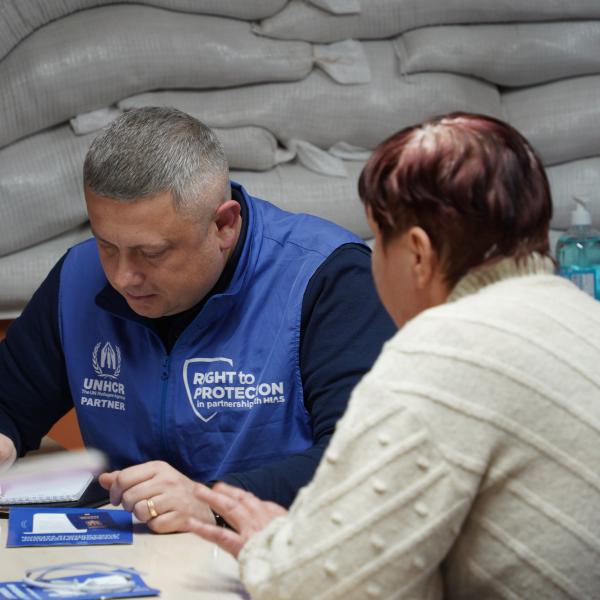
“Without my documents, I am nothing,” Ulyana sums up quietly. For two years, the former cook lived with the consequences of being invisible in the system. She could not buy a train ticket. She could not open a bank account. She could not receive state support. Even some forms of humanitarian help, such as warm clothing, required an ID.
In Dnipro, where she finally found safety near relatives who had fled earlier, Ulyana learned about Right to Protection, a local partner of UNHCR. There, she received free legal assistance. “They supported me every step of the way, with the migration service and the tax office,” she explains.
“The documents are the most important thing. Without them, you can access almost no form of support.” — Ulyana Shutska
Legal protection: the invisible lifeline
UNHCR’s work in Ukraine is not only about distributing blankets or repairing homes – even though this help is essential. Legal protection is a core part of the humanitarian response, because it opens the door to all other rights.
Without legal identity, displaced people struggle with daily tasks, from buying a ticket to working legally. They are more exposed to exploitation, human trafficking and exclusion. UNHCR teams and partners are active in transit centres, evacuation points and collective shelters across the country. They help people who were forced to flee to navigate complex administrative processes and recover lost documents.
With her new papers in hand, Ulyana now faces winter differently. “Thanks to these documents, I can receive other types of assistance and cash support. I will be able to buy a heater, warm clothes and more blankets,” she says. In the poorly insulated dorm where she lives, temperatures drop dangerously during the winter months.
What type of protection does UNHCR give?
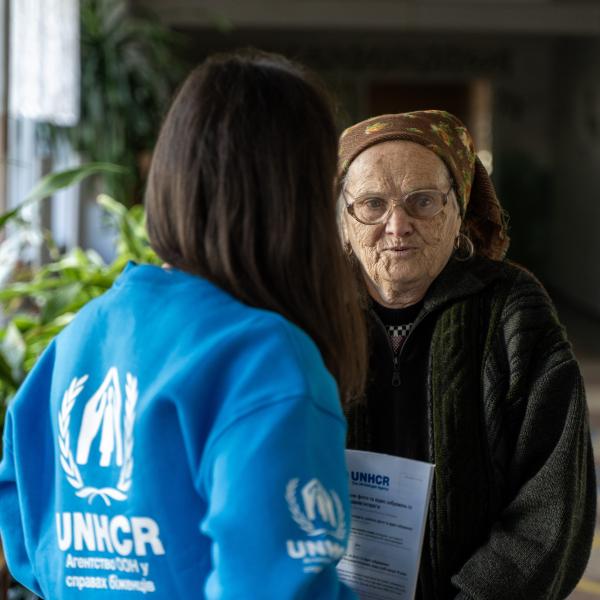
Protection is at the heart of UNHCR’s mandate. It goes beyond material aid. It means ensuring that the fundamental rights of refugees and displaced people are respected and upheld. It includes helping people access asylum and preventing any forced return to unsafe environments. It means providing legal assistance, including support to replace or obtain identity papers. It also means ensuring the physical safety of vulnerable groups and supporting access to shelter, healthcare and other essential services. At the same time, UNHCR works with governments to strengthen laws that protect displaced people and to find lasting solutions — whether through voluntary return when it is safe, local integration, or resettlement in another country.
Four years on, the crisis continues
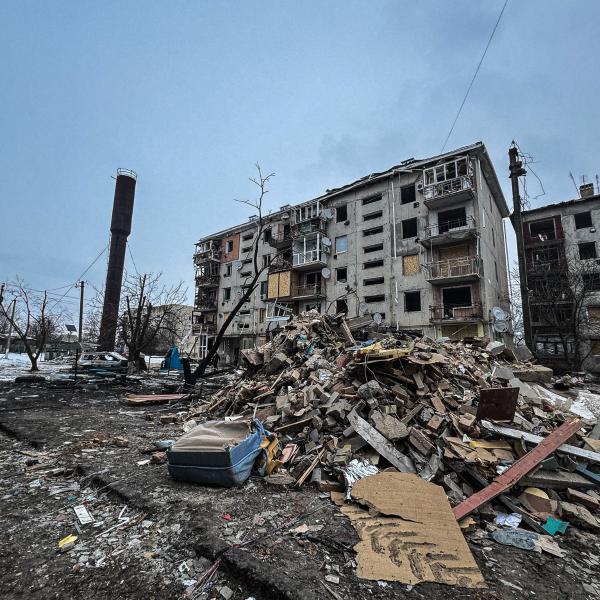
Ulyana’s story is part of a crisis that has not eased up. Air strikes continue almost daily, affecting both frontline areas and cities in the west of Ukraine. In November, an attack in Ternopil killed at least 38 civilians — the deadliest incident in western Ukraine since the start of the full-scale invasion.
Forced evacuations are increasing. Fighting is moving closer to communities. Infrastructure is damaged. Winters are harsh, often without electricity or heating. Families have no other choice than to flee in these urgent conditions. Many arrive at transit centres with only the clothes they are wearing. Some, like Ulyana, arrive without any proof of who they are.
“I am grateful that you support people like me. Thank you.” — Ulyana Shutska
Rebuilding, one document at a time
When Ulyana speaks about her journey, she does not dramatize it. She talks about daily challenges, about patience, and about her gratitude to those who helped her become “someone” again. Fundamentally, this is about lost dignity that was found once again.
The legal protection work carried out by UNHCR and its partners, such as Right to Protection or Proliska — recipient of the 2025 Nansen Refugee Award for Europe — may not make headlines. It does not produce dramatic images. But it changes lives in a very real way.
Today, Ulyana has her permanent identity card. She has opened a bank account. She can receive social benefits. She is slowly rebuilding a “normal” life. The winter was hard, but she is no longer invisible.
After four years of armed conflict, as fatigue grows among affected communities and the international community alike, these quiet stories of resilience remind us why support must continue. Because every person deserves to exist — legally, with dignity, and with hope.
FAQ on the situation in Ukraine and UNHCR's work
Why are identity papers so important for displaced people?
Without official documentation, displaced people cannot access state support, open a bank account, enroll in some aid programmes, or even access basic services such as healthcare and education.
How does UNHCR help people without IDs in Ukraine?
UNHCR works with local partners to provide free legal assistance. This includes guidance through administrative procedures, help to replace lost documents, and legal advice to access rights. This support is available in transit centres and reception sites across the country.
How many people have been forced to flee in Ukraine?
Millions of people remain displaced inside Ukraine. Between January and November 2025 alone, nearly 80,000 people arrived at transit centres after fleeing intensified fighting. Today, 3.7 million people are displaced within the country, while 5.9 million are refugees abroad.
What else does UNHCR do in Ukraine?
In addition to legal protection, UNHCR provides emergency shelter after attacks, psychosocial support, cash assistance, home repairs, winter supplies, and support to establishments hosting vulnerable people in frontline areas.